Google+

contact us

Use the form on the right to contact us.

Day or Night, we are here to serve you. Leave your plumbing problem to us.


Tinley Park, IL

(708)845-7922

Residential and Commercial plumbers and plumbing contractors available in Orland Park, Tinley Park, Oak Lawn, Palos Heights, Midlothian, Oak Forest, Homer Glen, Mokena, Frankfort, and the surrounding Chicago South Suburbs. Emergency plumbers.

copper water lines.jpg

Kevin Szabo Jr Plumbing Blog

Kevin Szabo Jr Plumbing is Tinley Park, Orland Park, Oak Forest, Midlothian, Orland Hill, Homer Glen, Mokena, Frankfort, Crestwood, Palos Heights, Oak Lawn, local plumber. Read our blog for advice, tips, a good laugh, and basic home improvement.

**We are moving our old blog to our new and improved website. Too see all our posts visit kevinszabojrplumbing.blogspot.com

How To Install A Dishwasher Supply Line

RH Business Marketing Solutions
Screen Shot 2020-07-07 at 3.44.54 PM.png

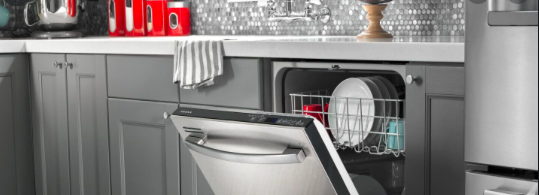
How To Install A Dishwasher Supply Line


Installing some appliances can seem like a daunting task if you don’t take care of some important details. For example, the installation of a dishwasher cannot take place unless there is an extension of the hot water supply line to the dishwasher and a connection of the drainpipe to the dishwasher. For an already installed dishwasher, replacement of the supply line is also a tad difficult if you don’t know what you’re up against. 


What is a hot water supply line?

Hot water is needed to wash the dishes. Where does that water come from? It comes from the hot water supply system at your house. This system consists of the heat source, water treatment apparatus, pipelines that transport water, and certain devices that maintain and control the temperature of the water. The main concern for the supply system when dealing with the dishwasher installation is the pipeline that is bringing the hot water to the dishwasher.


Dishwasher’s supply line:

The dishwasher’s supply line does not come with the dishwasher. It needs to be purchased from the plumbing supply store. It has a variety of lengths, varying up to 10 feet. Stainless steel supply lines are considered better than other materials. The supply line can get damaged if you do not take care of the following:


●      Make sure the shut-off valve is within reach.


●      When you don’t want to use the dishwasher for a long period, say a week or more, you must shut the valve off.


●      Regularly check the water supply line for leaks especially at the place where the hose is connected to the water supply shut off valve.


When do you need to change the dishwasher supply line?

As mentioned above, the comfort of using a dishwasher can turn into a disaster if an issue arises with the water supply line. You may have to replace the dishwasher supply line in case any of the following happens:


●      Less or no water reaches the dishwasher -- If there is no water in the dishwasher, then you need to check if the water inlet hose is properly connected and the valve should be in the open position. In case it was not properly connected or in a closed position, then fixing that would solve the problem. If there is less water, then you need to check the leaks and fix them. If nothing works, then you need to change the water supply line.


●      Frozen pipeline -- Another reason for your dishwasher not filling up with water may be that the water supply line could be frozen. It is a pretty serious problem as the supply line may burst at any time. Then you would definitely have to replace the supply line. 


●      Water under the dishwasher -- if the water starts filling up under the dishwasher, you need to check the water supply, check every connection to tighten and secure it. If the problem persists, then the cause may be a hole in the pipeline that should be fixed immediately as it may result in extensive water damage.


Installing a dishwasher supply line:

The whole thing can be a tedious process so you need to have all the tools and equipment at hand before you start connecting the supply line and the drainpipe to the dishwasher.


Tools and equipment required:

You will need the following tools to install a dishwasher supply line, along with the electric connections:

●      A power drill with a hole saw attachment

●      Screwdriver

●      Wrench

●      Pliers

●      Electrical tape

●      Teflon tape

●      Supply and drain tubes

●      T-fittings

●      Compression fittings

●      Wire nuts

●      Tube cutter


Precautions you need to take before the installation process:

You need to be very careful when installing the dishwasher as you will be attaching it with the water supply line and you may need to work with the electrical wires. You could end up flooding your house or get an electric shock if you do not take the following precautions:


●      Make sure you shut the water supply to the sink before you start the work.

●      Ensure that the power is off at the fuse box or the circuit breaker while you do any electrical work as it can have serious repercussions that may result in serious injuries even death.


Steps for installing a dishwasher supply line:

You can easily install the dishwasher supply line by following the steps given below.


1. Cutting the hole in the cabinet wall:

If you are installing the dishwasher for the first time, you will need to cut a hole in the cabinet wall. After you have ensured that the water supply is shut, you can start by drilling a hole in the cabinet wall separating the dishwasher compartment and the area under the sink. You should use a power drill to cut a round hole in the cabinet wall (of about 3-inches).


2. Attaching the drain line to the dishwasher:

Attach the drain line connection of the dishwasher to the main drain line pipe using hose clamps. You must secure the hose clamps by crimping them around the hose using pliers. With a tube cutter, cut the drainpipe under the sink. Then, attach a T-fitting to the drainpipe of the dishwasher. The T-fitting has a horizontal and a vertical part. The vertical part connects the dishwasher line to the drain pipe and the horizontal part connects the drain line.


3. Placing the dishwasher:

Now, the dishwasher needs to be placed under the countertop and you can push and slide it in place. After sliding the dishwasher under the sink, you need to level it with the countertop by balancing the height of the legs using a wrench. When you have adjusted it according to your requirement, secure it to the countertop with screws. Don’t forget to thread the hose through the hole in the cabinet wall. 


4. Attaching the hot water supply line:

To attach the water supply line to the hot water input valve in the dishwasher, you need compression fittings. Tighten the compression fittings using a wrench. You will need a tube cutter to cut the water supply line, after which you will install a fitting and connect it to the dishwasher’s water supply. Then, connect the dishwasher’s supply line to the hot water supply under the sink.


5. Turning on the water supply and switching on the power at the breaker:

After you are done connecting all the parts, turn on the water supply. Then connect the dishwasher’s drain line to the plumbing system. Switch the power on at the breaker and your dishwasher is ready for use. You have installed your dishwasher’s supply line. All that remains is to test if everything is in working order.


6. Testing the supply line:

After successfully installing the dishwasher or replacing the supply line, check the supply line and the drain line for any leakages or problems. Check if the dishwasher gets filled up with water easily and the drain line is also working properly. In case there is some issue, check all the connections again. If the problem still persists, contact a professional plumber to check things out. 


If you follow the 6 steps properly and take the necessary precautions, you will have no trouble at all in installing your dishwasher or replacing the supply line. I hope these easy steps will make your work a breeze and you will be using your dishwasher in no time.

Guest Contributor: Aisha S

DO YOU DIY?

RH Business Marketing Solutions


Screen Shot 2020-07-07 at 2.55.16 PM.png

Originally posted on Porch.com

Call it the HGTV effect, or blame the viral influence of Pinterest. Young Americans are increasingly interested in home improvement, whatever the reason, and many are taking matters into their own hands. According to one recent survey, millennial homeownersnow spend about $26,000 annually for home upgrades each year. And much of that spending is for DIY projects: Retailers have seen an uptick in purchases among young customers buying supplies.

But does this enthusiasm translate to real home improvement know-how? After all, older generations are always faulting millennials for their lack of humility and focus, essential ingredients for DIY success. Can baby boomers and Gen Xers still teach the digital generation a thing or two about homeownership?

We decided to find out, asking members of each generation to assess their handiness around the house. We then put their assertions to the test, asking which repairs they’ve actually done. Finally, we quizzed them on basic home maintenance knowledge to see who possesses the real expertise. Our findings? Millennials think they’re adept at a variety of home improvement tasks—but in experience and knowledge, the numbers show differently.

Each Generation’s Self-Perceived Skills


While a significant portion of each generation claimed it was pretty handy, no group touted its home improvement skills more highly than millennials. This confidence was particularly apparent among that generation’s men, of which 78.6 percent identified as handy. By contrast, fewer than 70 percent of Gen X and baby boomer men said the same. Similarly, a greater percentage of millennial women claimed the “handy” mantle than in any other generation.


Based on millennials’ self-assessment of their skills, their generation’s reputation for being hopeless at home maintenance may be unwarranted. Young Americans have held off on buying homes longer than generations prior, so they may be used to calling someone else to handle maintenance. Indeed, among respondents, millennials had far lower rates of homeownership than older generations—leading us to wonder how they learned the handy skills they claim to have.

Are millennials exaggerating their proficiency when it comes to repairs, or do they get too little credit when it comes to practical skills? To find out, we ask for more detail about their handy habits, including who takes the lead when something breaks.

Who Fixes It?

Screen Shot 2020-07-07 at 2.55.40 PM.png

When something at home stops working, calling a professional can spare stress and uncertainty. But for the majority of millennials, that path seemed too easy—or costly. Fifty-five percent preferred to handle repairs themselves, compared to roughly 43 percent of baby boomers and Gen Xers. Home improvement retailers are hoping this DIY ethic persists among millennials as millions leap to homeownership after holding off for years.

Gen Xers, conversely, relied on their spouse or partner for repairs more often than other generations did. Baby boomers were the most likely to hire a professional, though, perhaps because they’re growing old enough to be more hesitant to safely perform some repairs themselves. Recently, contractors nationwide have benefited from a surge in baby boomers remodeling their homes to accommodate them better as they age.

Comparing Repair Resumes

Screen Shot 2020-07-07 at 2.55.53 PM.png


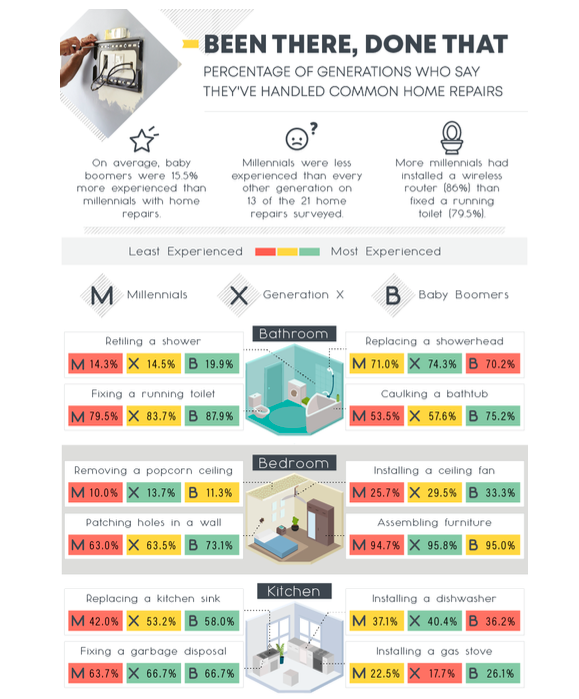
Calling oneself handy is one thing, but acquiring a record of successful fixes is another. When we asked each generation what repairs they’d performed in the past, millennials had the most limited track record, despite their self-professed competence. In fact, for 13 of the 21 repairs studied, millennials had the least experience. When they did surpass other generations, it was often due to their superior tech savvy: They were most likely to have set up a wireless router and mounted a TV, for instance. Millennials were also more likely than their older counterparts to perform some other varieties of “adulting” unrelated to home repairs, such as an oil change or cooking for a dinner party.

It might be easy to dismiss the gulf between millennials’ DIY confidence and their experience as mere arrogance. But perhaps older generations have simply had more time to experience all the challenges of homeownership and reassess their own skills accordingly. After all, if you’re only familiar with simple fixes like installing a showerhead,you might draw the erroneous conclusion that all home repairs are as easy. So in addition to quizzing participants on what they have done in the past, we asked them what they knew about home repairs.

Bungling the Basics?

Screen Shot 2020-07-07 at 2.56.11 PM.png


To further study differences in DIY knowledge among generations, we quizzed respondents on basic facts that informed home improvement projects. In this regard,nearly 1 in 5 millennials could not correctly identify the difference between a flat head and a Phillips head screwdriver. Among baby boomers, by contrast, less than 10 percent made this error. Even on slightly more difficult subjects, like naming the purpose of an auger bit, the oldest generation surpassed younger counterparts. Nearly two-thirds of baby boomers could do so successfully, compared to just 61.2 percent of Gen Xers and 51.4 percent of millennials.

Younger folks did outperform older Americans in one respect, however: knowledge of the metric system. Among Gen Xers and millennials, about 7 in 10 correctly identified the number of millimeters in a centimeter, whereas a smaller portion of baby boomers answered this correctly. Perhaps we can cut them some slack: It’s been several decades since baby boomers may have absorbed this content in grade school.

Toolkit Troubles


Individuals with repair experience should at least be capable of naming common tools, even if they’re less than an expert in wielding them. Sadly, sizeable segments of millennials could not identify a range of common instruments: Just 73 percent could correctly name a C-clamp, and even fewer knew what to call a hacksaw. Here, knowledge improved with age in all cases. Gen Xers were slightly better at naming every tool, and baby boomers were the best.

Even when asked to identify the purpose of a Spackle knife, just 84.2 percent of millennials could do it. Compare that to 93.3 percent of baby boomers, and the future of America’s walls starts to look a little grim. Millennials were more inclined to guess the tool was used in painting than other generations, perhaps confusing it with the more slender painting knives often used by television’s favorite painting instructor, Bob Ross.

The Demographics of DIY Knowledge

When we consider the results of our quiz in their entirety, it’s clear DIY knowledge declined with each successive generation. This was true among both men and women, as each gender experienced an inverse correlation between knowledge and youth. Regarding both know-how and experience, millennials overstated their DIY abilities when asked if they were handy.

Interestingly, those who lived in mobile homes scored best on our DIY knowledge quiz, outperforming even those who lived in houses. Given the special difficulties that upkeep of a mobile home can entail, perhaps we shouldn’t be surprised that this group was well-informed. Homeownership of any kind was associated with higher scores. In fact, those who rented performed even worse than those who lived with their family. Perhaps that cohort is forced to make repairs around the house rather than chipping in on rent.

No Shame in Calling in the Experts

So maybe some of us tend to overestimate our skills around the home—if your DIY optimism turns disastrous, applaud yourself for the initiative at least. As with any other skill, repairing or remodeling a home requires practice, which you can only gain by making a mess or two. But when things start to get overwhelming, don’t let pride prevent you from getting the professional assistance you need. After all, doing it yourself doesn’t feel so great when the job’s done wrong.

Of course, when you call in the pros, you want to make sure they have more experience and skill than you do. That’s where Porch comes in, with competitive quotes from trusted home improvement professionals. We even offer handy cost estimates for common projects so that you can budget with confidence. Sometimes the only thing better than doing it yourself is realizing you don’t have to.

Methodology

To compile the data above, we surveyed 1,010 respondents aged 18 and older from Amazon’s Mechanical Turk. The participant gender breakdown totaled 540 women, 469 men, and one individual who identified as neither. Because the data we present rely on self-reported abilities and histories, they may not be perfectly representative samples of all generations and genders. These data are meant solely for entertainment purposes, although we made every effort to represent the data as accurately as possible.

Fair Use Statement

Feel free to use our images and information for noncommercial purposes. When you do, we hope you’ll attribute us by providing a link back to this page. As all DIYers can attest, it feels good to get some credit for your work.

Guest Contributor: Evan Dunn

Bathrooms We Are Currently Loving

RH Business Marketing Solutions

Basin Bowl Sink Bathroom

Basin Bowl Sink Bathroom

White Themed Farm House Bathroom

White Themed Farm House Bathroom

Mosaic Marble Shower

Mosaic Marble Shower

Modern Dark Theme Tub and Shower

Modern Dark Theme Tub and Shower

Contemporary Cage Shower

Contemporary Cage Shower

Glass Shower with Mosaic Shower

Glass Shower with Mosaic Shower

Shiplap Bathroom Remodel

Shiplap Bathroom Remodel

Top 5 Tips on Smart Home Repair 

RH Business Marketing Solutions

Screen Shot 2020-06-29 at 8.48.52 AM.png

Top 5 Tips on Smart Home Repair 


Home automation is becoming prevalent because of its convenience, to the point where it practically works like magic. You can control your entire house with a click of a button, the sound of your voice, and sometimes, from anywhere in the world. In fact, it is estimated that the global smart home market will exceed $53 billion. But every now and malfunction can occur. 

Technology may not always be 100% perfect and is one of the arguments against smart homes, but sometimes, all it needs is a simple fix. 

In this guide, we will provide solutions to 5 smart home repair problems that are experienced with smart home products. 

1. Have You Tried Restarting? 

We have all heard this advice when working with any device and albeit for good reason. The IT department or customer service agent is not just being lazy when they ask this question. Turning your device off and switching it back on again can fix the problem. 


If the problem persists, it might be your modem or router that needs rebooting, or it might even be the problem itself, more on smart home Wi-fi problems in the next step. 

2. Check Your Wi-Fi


You may experience hiccups with the connection, such as your smart switch not connecting to Wi-Fi. When it comes to the placing of your modem or router, your device may have trouble staying connected or respond slowly due to an unstable bandwidth. 

This is what technicians refer to as a “dead zone”. The best solution is to move it to the middle of your house and preferably on higher ground such as an upper floor. Devices work better the closer they are to the Wi-Fi source. Signals also travel downward, so placing it higher can improve your Wi-Fi significantly. 

Your router may also be transmitting two wireless frequencies: 2.4 GHz and 5Ghz. Simply put, your smartphone might be connected to one of the frequencies and your smart home device to another, so make certain they are all connected to the same one.  

3. Update Your Software

Smart home failures can be avoided by merely updating your software. All devices, including routers, will need to be updated periodically for the purposes of seamlessness and security, which are highly prioritized in a smart home.  

While most modern devices update automatically, older models may need you to manually do it yourself, so don’t be too worried if your device confirms your email address, password, location, or asks you to download a file. Of course, do be careful as not all pop-up messages are for updates. 

If it states there is an error, you may have to read up on the manual, check forums or FAQs on the site, or contact a customer service agent for your product. 

4. Fix Hardware

When you pertain to smart home repair it may require you to probe into your hardware too but only if you are an expert in the fields of electrical or hardware, no one wants to get into any serious accidents. 

If you’re like the rest of us who might be able to spot these issues but don’t know how to fix them, the best thing to do at this point would be to contact the manufacturer or consult handyman professionals such as HandyKith, for example.

5. Power Problems


Our last tip on the list of smart home complaints would be to ensure that you have a dependable power supply. Being a smart home, everything will be running on power, so it is important to correct any power issues causing the problem.  

There is no harm in guaranteeing that your cord hasn’t come loose or that you don’t have other wiring problems before looking for other possible malfunctions. You can also start supplying yourself with rechargeable batteries and adjust settings to conserve energy. Most devices will come with an LED indicator to display whether your device is receiving power. 

Conclusion

Next time you stumble upon problems with your smart home, keep these tips in mind. If you have any problems setting up, let us know as there might just be a simple solution.

About the Author 

The author has experience working with a few fully-equipped, high quality rated, professional contracting companies like HandyKith, that specializes in all kinds of house repairs and installations, including smart home repair. She has been a smart home enthusiast over the years and educates about the advantages of having smart homes.

Guest Contributor: Clyde Kincaid

How You Can Best Prevent Water Leaks in Your Home

RH Business Marketing Solutions

How You Can Best Prevent Water Leaks in Your Home

A flooded home is every homeowner’s worst nightmare. However, much of the water damage in American homes comes from inside the house. Roof, pipe, and slab leaks can cause thousands of dollars in damages and require extensive cleanup. In this article, we’ll review what commonly causes indoor leaks, what their economic consequences are, and how you can work to prevent them from occurring in your own home.

What commonly causes home water leaks?

Most indoor water leaks have one of two origin points: your roof or your pipes. As you might imagine, roof leaks are caused by an issue with your home’s roof. In most cases, this problem starts small—a few missing shingles, or a piece of flashing out of place—but soon evolves into a major mess. Your roof’s shingles or tile are its protective shield against the elements. Any gaps in this armor exposes the underlayment, and then the roof structure itself, to moisture from rain and snowmelt. Under these conditions, a roof leak is only a matter of time.

Pipe leaks are generally caused by either the deterioration of the pipe—which can happen to metallic pipes in older homes—the shifting of the home, or, perhaps most commonly here in the Midwest, the pipe freezing on a cold winter night. As the water in your pipes freezes, it expands, putting incredible pressure on the pipe itself. This stress can cause the pipe to pop open like a frozen soda can, sending water flooding into your home. As we’ll discuss below, frozen pipes require the intervention of a professional who has the right tools and slow approach to safely thaw the pipe out.

Some pipe leaks occur underneath your home’s foundation slab. Appropriately, these are known as “slab leaks,” and they can be difficult to access or detect. Most homeowners first notice a slab leak when they see massive usage increases on their utility bill. As with other pipe leaks, you’ll need to bring in a professional plumber to help you pinpoint the leak’s location and access it.

What are the consequences of water leaks?

In a home, water is a highly destructive force. A pipe leak, burst pipe, or leaking roof can damage your floors, foundation, drywall, ceilings, and furniture—nothing in your home is immune. Indoor water damage creates the ideal conditions for mold to grow, causing a potential safety hazard for you and your family. All-in-all, insurance claims for water damage and leaks top $2.5 billion annually, making it one of the most expensive home repairs out there. What’s worse is that insurance doesn’t cover every type of leak, which means homeowners end up paying about $2,800 out-of-pocket for cleanup and repair.

Preventing water leaks

Just like all home problems and needed repairs, not every leak can be prevented. Some things are just out of your control. However, the right preventative maintenance and proactive forethought can make a difference and help you avoid many potential disasters.

Roof leaks

Preventing roof leaks is as simple as keeping your home’s roof in good shape. We recommend you have a roofer out to your home at least once-per-year in the spring to assess your shingles and make sure your roof made it through winter okay. Then, in the other seasons of the year, get up on a ladder and take routine looks at your roof. If you notice ripped-off shingles after that latest storm, it’s time to take action. Call a roofer and get it fixed before the underlayment is damaged.

Older pipes

If you own an older home, it’s probably a good idea to talk to your local plumber and get a report card on the property’s pipes. Most metal pipes need to be replaced every 70-80 years. If your home was built in 1950, for instance, you’re probably coming up on the maximum lifespan of your copper, brass, or galvanized steel pipes. A home plumbing inspection might be a good idea.

Frozen pipes

To keep your pipes from freezing, you should schedule your annual furnace tune-up with an HVAC professional. This inspection and preventative maintenance ensures that your heater is in its best-possible condition heading into the freezing nights of winter, making it far less likely to break down and expose your pipes to below-freezing conditions. For long-term added protection, you might also want to talk to your plumber about sheathing your pipes in insulating material. This slows down the temperature exchange, buying your pipes many extra hours in the event your heat goes out on a January night.

As it turns out, there’s a lot homeowners can do to prevent water leaks and avoid major problems. Be sure to check out the infographic below,, for even more advice on avoiding water damage and expensive cleanup costs.

Guest Contributor: Amanda L

5 Bedroom Decoration Ideas to Improve Your Sleep

RH Business Marketing Solutions

Screen Shot 2020-06-18 at 11.15.02 PM.png

5 Bedroom Decoration Ideas to Improve Your Sleep

Studies have shown that decor is indeed one of the factors that affect how well we sleep or if we sleep at all, the decoration of your bedroom has an impact on you on the psychological level and that’s what affects your sleep.

Your bedroom could make you feel stressed or it could make you feel relaxed and that plays a major role in your sleep process, when you’re stressed your body starts producing stress hormones that work on keeping you awake and alert which as a result prevents you from sleeping. And when you are relaxed your body starts producing sleep-inducing hormones that promote relaxation in your body so you can wind off and sleep deeply.

It is not just about falling asleep or not, it is also about the quality of your sleep, you sleep better when you are relaxed, you wake up more refreshed and energized so you are ready for the day ahead while sleeping stressed leads to low quality sleep that is never enough for making you refreshed or energized.

So here are 5 bedroom decoration ideas to improve your sleep:

There are five elements to the decoration ideas we are going to suggest for better sleep, these elements contribute to your mood and the overall feeling you get when you are in your bedroom so it is important to get those elements right so you can have a peaceful night of deep refreshing sleep, these elements are:

  • Curtains

  • Lighting

  • Color

  • Bedding

  • Organization

Curtains

Using blackout curtains to keep the daylight out of your bedroom is important for keeping the room as dark as possible so you can sleep peacefully no matter what time is it of the day. Curtains can help to control the amount of external light that gets into your bedroom and if you are a light sleeper that could wake up easily because of light or any other disruption then blackout curtains could be huge for you because it is a truly effective way of keeping light outside of your bedroom.

Lightings

You need to take special care of the lighting of your bedroom if you want to enjoy a restful sleep. You need to pick lights that have low light intensity because it has been proved that high light intensity lights cause the suppression of melatonin production which is a very important hormone that the body produces to promote sleep.

You need to pick the right wavelength of the light also, because shorter wavelengths such as blue have been known to suppress the production of melatonin. You can use instead long wavelengths which don’t have any effect on the production of melatonin.

Color

Picking the right color is also an important factor in how your bedroom will make you feel, science has proved that the best color for bedrooms is blue it helps your body relax and unwind from the stresses that you have been facing all the day, when you enter your blue decorated bedroom you will feel like you have gone into a different world because of the relaxation this color can provide to you. 

Yellow and green are also great choices for your bedroom colors, they can help promote relaxation and make you less stressed when you are in the room.

Bedding 

Luxurious bedding is part of your bedroom decoration and is part of how well you sleep, the soft touch of the high thread count Egyptian cotton sheets is unbeatable and will make you relax in a matter of seconds or the silk sheets that can make you feel like a queen.

Luxurious bedding has the ability to make you never want to leave the bed, if you have the right sheets your relationship with your bed will be a love story. So make sure you invest in your bedding because it has the ability to make you sleep better.

Organization

An unorganized space evokes stress in the human psychology, we need the space that we exist in to be organized, to has patterns, less chaos and more organization, this is what we seek. And with our bedrooms nothing changes, we need our bedrooms to be in order and well organized so we can sleep and relax, because an unordered space can irritate us out of the optimal sleep state that we need.

Conclusion

So these were the five decoration factors that have an impact on how well you sleep, each factor on its own might seem minor but when these factors are combined they will probably have a significant impact on how good or bad you sleep. 

So make sure to follow the bedroom decor recommendations in order to get the best out of your sleep.

Author Bio

Karim is the founder of bedsisland.com, a website that focuses on sleep and everything related to it,  he has been blogging about sleep for over two years now and has a deep curiosity that leads him to explore every aspect that sleep impacts in our lives.

Guest Contributor: Karim Mohamed

Our Very Best Home Maintenance Tips and Tricks

RH Business Marketing Solutions

Our Very Best Home Maintenance Tips and Tricks

There’s typically a point where many new homeowners, when confronted with a major home emergency—such as a broken furnace or a busted pipe—will wonder what exactly they got themselves into by buying a home. It’s true: owning a home can be filled with unexpected challenges and expenses. 

The best way to get on top of things? Put together a home maintenance budget and make preventative maintenance your focus as a homeowner. In this article, we’ll walk you through how to do both, and what you should prioritize when it comes to caring for your home.

Set your home maintenance budget

For many homeowners, setting aside the right amount for their home’s maintenance and upkeep requires trial-and-error. Over time, you’ll eventually settle on a number that you know from experience works for your home. However, if you’re a new homeowner or recently moved into a new home, a good rule of thumb is to set aside 1-2% of the value of your home into a home upkeep savings account. That means a homeowner whose home is worth about $250,000 should save somewhere around $2,500-$5,000 every year.

Bear in mind that your home’s mileage may vary. Older homes require more maintenance than newer ones. Homeowners with pools on the property should set aside more than those without. If you are capable of setting aside and saving more, you should do so: worst case, you’ll roll over some of that money to the next year and have a “rainy day” emergency fund set up for your home’s future.

Take care of your cooling and heating systems

Your home’s air conditioner and furnace represent two of the largest investments in your home outside of the structure itself. Keeping them in good working order should be one of your highest priorities as a homeowner. A professional tune-up helps do just that, while also making your HVAC systems operate more efficiently. This matters: your cooling and heating systems account for nearly half of your home’s energy use. Making both more efficient can really pay off throughout the year.

We recommend that you set aside some of your home maintenance budget for annual tune-ups for both systems—one in the fall to get your furnace ready for the winter and one in the spring to prepare your AC unit for our summer heat and humidity. Call a local HVAC pro in your area to schedule your HVAC maintenance.

Energy-smart decisions can really pay off

If you have some of your maintenance budget left over at the end of the year, consider reinvesting that extra cash into your home. A good place to start is with energy-efficiency upgrades. Why? Well, for one, these upgrades help prime your home for future savings, which means they can eventually pay themselves off through lowered electric and gas bills. Second, making your home more efficient can reduce the wear-and-tear on both your air conditioner and furnace. This means lower maintenance and repair costs moving forward.

Plus, not all of these projects carry a large upfront cost! Even something as simple as replacing your home’s air filter at regular intervals can improve the efficiency of your HVAC systems by up to 15%. That’s less than five minutes of work that can really pay off down the road. Similarly, you can cut your monthly electric bill by swapping out your old light bulbs for energy-efficient LED or CFL bulbs. These changes take very little money upfront, but can yield month-over-month savings.

The long-term value of home maintenance

It may not be immediately apparent, but preventative maintenance and energy-saving upgrades do pay off over time. As a homeowner, you’re in this for the long haul. The right decisions now, in the present, will have positive ramifications on the future of your home.

Guest Contributor: Amanda L

Eco-Friendly Design Solutions to Make Your Home Greener And Healthier

RH Business Marketing Solutions

Eco-Friendly Design Solutions to Make Your Home Greener And Healthier


Green architecture has gained in popularity immensely over the last couple of years and this trend is sure to continue in the future. Architects from all around the world are constantly searching for innovative ways to make their new projects even more environmentally-friendly and energy-efficient, and thus help the entire green movement grow even further. Having this in mind, we’ve singled out five eco-friendly design solutions for making your home greener in 2020 (and beyond). Let’s take a look and get inspired.

Prefabricated homes as a way of reducing waste

In case you’re not familiar with the term, prefabricated homes are the ones that are built off-site and then assembled on the owner’s lot. This may sound strange at first, but once you consider all the benefits of such a building approach, you’ll understand why the popularity of prefabs won’t fade away any time soon.

 First of all, home builders in factories have a vast experience in pre-building homes so they will make sure to reduce the amount of waste to a minimum. On top of that, these homes have shown to be much more durable, and they definitely take less time to be constructed, since building takes place indoors and it doesn’t depend on weather conditions which means that there shouldn’t be any significant delays.

3.jpg

Locally treated sewage as an eco-friendly method

Aside from concentrating solely on your home design, you shouldn’t forget other aspects such as sewage. This is extremely crucial since for hundreds of years all the waste from massive sewers has been diverted into a single area and then dumped into the sea. Such an approach has polluted the oceans severely and consequently harmed our environment. 

Therefore, it’s no surprise that the idea of handling wastewater locally has become super-popular among green architects. They’ve realized that sewage can be used as a resource for irrigating one’s landscape. So, instead of continuing with the non-efficient method that has only done harm in the past, you can actually make good use of that resource and manage to lower your environmental impact simultaneously.

Solar energy as a green alternative for powering a home

Relying on solar energy to power a home is another solution for reducing your carbon footprint. For homeowners who live in sunny places such as Australia, Malaysia, Philippines, as well as some parts of the US, installing a solar system would be a wise investment as they provide optimal conditions for power generation. Other than getting high-quality solar panels, it’s also necessary to invest in solar system add-ons such as charge controllers and batteries. 

You’ll also need to convert the energy you store into a usable one. For that to happen, you’ll need to invest in another crucial component such as the SMA inverter. Doing so will ensure optimal performance and maximize the solar system’s efficiency. Finally, owing to the amazing professionals, it’s extremely easy to get this system installed nowadays and thus add that final touch to your home design.

Downsizing as a way of preserving the environment

Some people may find it difficult to give up the comforts and luxuries of living in extravagant, large homes. However, what they don’t realize is that homes with an average size of 186 square feet can be equally cozy and, at the same time, more beneficial for the environment. Firstly, these homes are extremely energy-efficient, and owing to this, the annual release of CO2 pollution is significantly lower. Secondly, smaller houses offer other major benefits as well, including mobility, affordability, and lower monthly bills. Finally, it’s important to remember that a smaller home also means fewer hours spent cleaning, as well as less money spent on expensive cleaning products.

4.jpg

Recycled materials for environmentally-conscious construction

Finally, another trend in the green architecture that is bound to become a true craze is building with recycled materials. Due to the use of sustainable materials, there will be significantly less waste which can seriously harm the environment. Even things such as plastic bottles, cans, and car tires that we’d usually just throw away can all be recycled, used in construction, and put to good use. Finally, the use of recycled materials, aside from being extremely responsible, can be very cost-effective as well. What this means is that you’ll be able to invest that money into some other green home improvement solutions and turn your home into an earth-friendly living space. Lastly, don’t forget that recycling is the future.

As you can see, there are some quite interesting green design solutions for eco-conscious homeowners. Going green brings numerous advantages and provides you with a chance to do something great for the environment while cutting down on unnecessary costs. Finally, don’t forget that every single detail matters and that only united we can turn our planet into a much healthier place to live on.

5.jpg


About the author:  Mike Johnston is an avid blogging enthusiast and experienced content writer with a focus in real estate, home improvement, and the construction industry.

Guest Contributor: Mike Johnston

Remodel Your Kitchen: Here Are 10 Reasons Why

RH Business Marketing Solutions

Remodel Your Kitchen Here Are 10 Reasons Why.jpg

Remodel Your Kitchen: Here are 10 Reasons Why

Remodel your kitchen to your liking. The kitchen is where you prepare delicious meals for your family. A hearty meal shared in the dining table is one way to create a stronger bond with each family member. That's why it pays to have a kitchen that is functional enough to serve this purpose. 

Take a walk through your kitchen and assess whether it's time for some remodeling. It can entail some cost, but it wouldn't match the convenience you'll have once make the most out of this change. 

To guide you through your decision making, we have put together 10 reasons why it's already time to remodel your kitchen.

1. Energy Savings

A lot of equipment has upgraded to have an energy savings feature. Now that the cost of electricity is getting high, it's time to invest and upgrade your kitchen equipment because it will pay off in the long run. 

2. Lifestyle

Food preparation depends on your lifestyle. What worked for you before might not be working for you now. Your preferences can change and expand. It's time to look around your kitchen and check whether you will need some addition or removal. 

3. Deterioration

A lot of action is happening in your kitchen, so it's inevitable that some spots would run down. Tiles can break from food preparations; cabinets might be too old already, some appliances might no longer be useful, and so on. Check your kitchen for any signs of deterioration and address it to prevent more significant problems to happen. 

4. A Fresh Look

Cooking also needs some motivation. If you feel like you need to move some things around to rechannel positive energies, then do so. A fresh look can reinvigorate your love for your kitchen. 

5. Modernity

Technological developments are sprouting left and right. Don't let your kitchen be left behind. These developments mean to cut short your preparation time. Give your kitchen a touch of modernity by upgrading your kitchen equipment or by changing your kitchen environment. 

6. Special Needs

Needs can change over time. If you have a differently-abled family member, then it's time to remodel your kitchen in a way that would cater to their needs. 

7. Gourmet Kitchen

If you're someone who spends a lot of time in the kitchen, then we're sure that you're gradually remodeling your kitchen to achieve your dream kitchen. It can take time, especially that kitchen equipment can be pricey, but you'll eventually get there. 

8. Home Improvement TV

You might have bumped into a home improvement show on TV, and this gave you some kitchen remodeling ideas. Act on this inspiration if you think it will be for the best. 

9. Financial Incentives

Upgrading your kitchen equipment into energy-saving ones can give you a consistent financial incentive. Some governments offer rebates if you exchange your current material to energy savings one. 

10. Value

If you are planning to sell your property, remodeling your kitchen can increase your property's value. It would be best if you renovate your kitchen in a way that will be appealing to potential buyers.

There you have it! You have many reasons you can go to on why the need to remodel your kitchen. So, look around, and start to remodel your kitchen.

Guest Contributor, Dana Laksman

Top plumbing repairs that shouldn’t be ignored

RH Business Marketing Solutions

Top plumbing repairs that shouldn’t be ignored

Our lives are hectic. In between the hustle-and-bustle of dropping the kids off at soccer practice, getting groceries, going to work, and finding time for relaxation every now and then, it’s easy for home maintenance to get pushed to the proverbial backburner. However, when your home is faced with urgent plumbing repairs, the issue may not be able to wait. Here are the major plumbing issues that require fast action on your part.

Sewer line issues

Just mentioning the words “sewer backup” to any long-time homeowners is probably enough to give them the shivers. Sewer line issues are among the most expensive and messy of plumbing disasters. The key to avoiding a sewer backup and an incredible amount of damage to your home is taking quick action at the first sign of a problem. So, just what do you need to look out for?


Sewer line clogs are most commonly caused by organic (grease, oil, eggshells, flour, coffee grounds, and more) and non-organic (sanitary products, “flushable” wipes, trash) waste that is put down the kitchen sink or toilet and becomes trapped deep in the line, forming a partial clog. Eventually, with enough time, this will fully clog the line, preventing wastewater from exiting your home into the municipal sewer or your septic system. The telltale sign of a sewer line clog is all of your sinks, drains, and toilets clogging at once. When this happens, immediately turn off the water supply to your home and call a plumber for emergency service.


Sewer line cracks and leaks also represent a potential problem. As the ground shifts around your line or tree roots burrow around it, parts of the line can crack or separate, leading to a leak. On the surface, you’ll probably notice a perpetually wet spot in your yard and smell the problem when above it. This is your time to call a plumber. Unfortunately, a sewer line leak isn’t going to resolve itself, and a leak can attract nearby tree roots, making the problem much worse.

Frozen pipes

On the coldest of winter nights, your home’s pipes are at risk of freezing. In cities throughout the Midwest and Northeast, plumbers get thousands of calls every winter about frozen pipes. There are two common, yet untrue, myths about frozen pipes. The first is that do-it-yourself thawing tricks, such as using a hairdryer, can safely and effectively thaw out a pipe—this can actually damage the pipe and increase the risk of a burst. The second is that homeowners can just ignore the frozen pipe, as it will eventually thaw out. This is also untrue.


First, consider what happens when the water in a pipe freezes. As anyone who has left a can of soda pop in the freezer too long can tell you, liquids expand as they freeze, occupying more space than they once did. When the water in your pipes freezes, it, too, expands, putting immense pressure on the interior walls of the pipe. A pipe burst is what happens when the pipe walls can no longer take the pressure. This pressure is cumulative, so just letting frozen pipes stay frozen and procrastinating means you could be flirting with disaster.


Most frozen pipe incidents occur when the property’s furnace stops working: that’s what allows indoor conditions to get cold enough for pipes in exterior walls to reach the freezing point. If your frozen pipe issue is accompanied by a malfunctioning furnace, you can’t expect your pipes to thaw out on their own anytime soon.

Water heater problems

Tucked away in your garage, utility closet, or basement, it’s all-too-easy to ignore your water heater. Yet, as water heaters age, they generally start to show signs of trouble that can serve as the proverbial “canary in the coal mine” for a disastrous tank burst. 


Standard water heaters contain an important component—the sacrificial anode rod—which draws corrosion away from the tank walls. Once this rod has been eaten through, however, that corrosion will start to attack the tank itself. This can weaken it. Just like in the frozen pipes scenario, your water heater is under pressure. Under normal conditions, the tank is more than built to handle this sustained pressure. In a corroded and weakened state, however, it will have issues.


Typically, this begins with water leaks, as small fractures in the tank shell allow water to escape the tank and start pooling under the system. If you notice water gathering around the bottom of your older water heater, that’s as good a sign as any that you need to call in a plumber right away. Left untreated, these fractures will continue to expand and multiply as the shell weakens. Eventually, the tank could burst open, flooding your basement, closet, or garage with water.


Old age comes for everything—including your water heater. If yours is more than 10-15 years old, keep an eye on it and don’t wait to call a plumber at the first sign of any trouble.

Be proactive and take care of your home

One of the main things that separates happy homeowners from stressed-out ones is proper home maintenance, upkeep, and proactive action. When it comes to your home’s plumbing—and, for that matter, many other aspects of your home—procrastination and delay are the enemy, and only increase the risk of something disastrous happening. When in doubt, bring in a plumber: as the old saying goes, it’s better to be safe than sorry.


If you’re looking for even more great tips for maintaining your home—including your pipes, HVAC systems, roof, and more—check out this infographic .It’s your guide to other home repairs that you should never ignore.

Guest Contributor: Amanda L